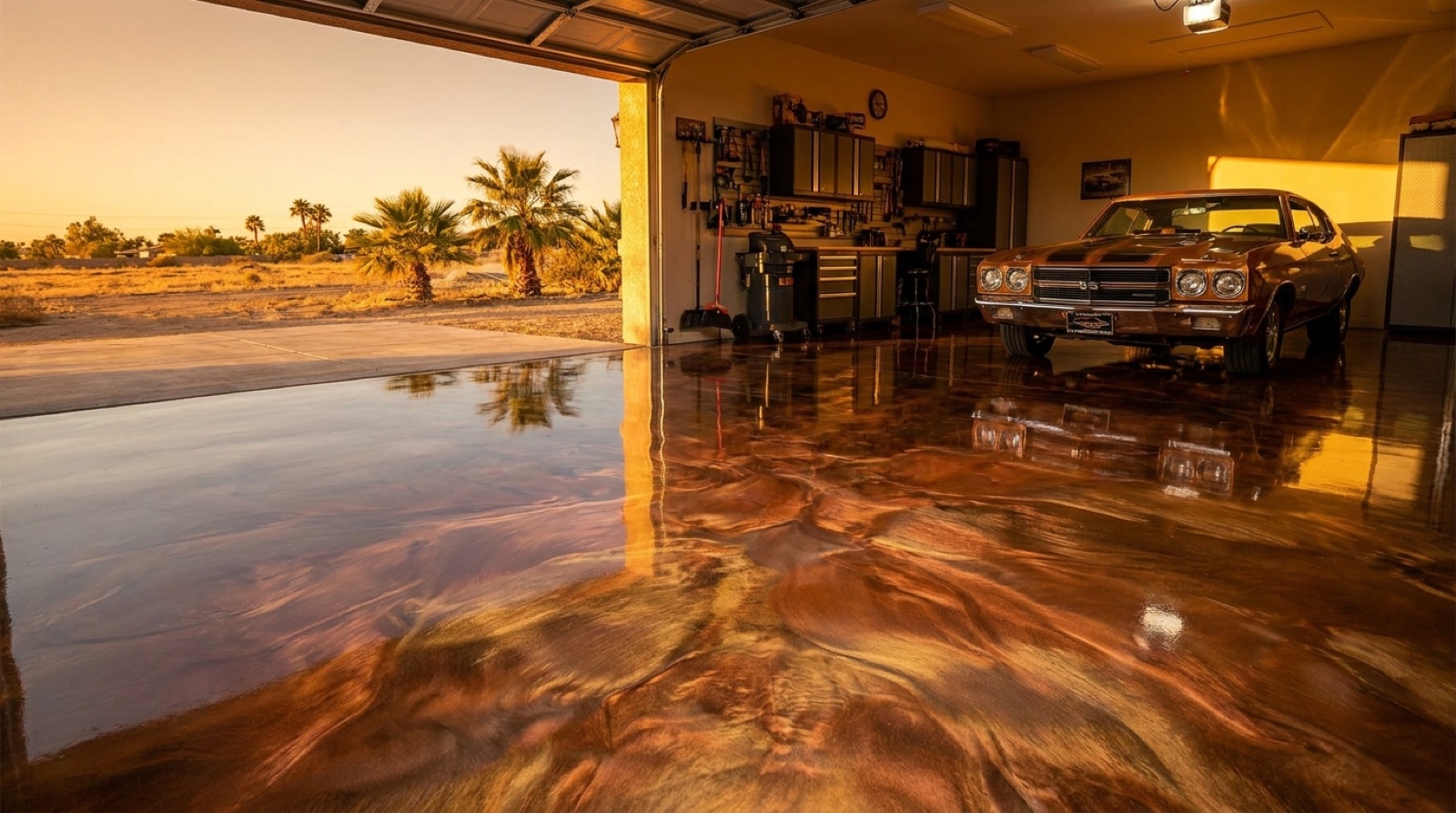
Orange County gets 280+ sun days a year, with summer surface temperatures on bare concrete reaching 140°F+ in August. Standard outdoor coatings — acrylic sealers, asphalt emulsions, even pure epoxy — fail under that load within 18-36 months. Polyaspartic is the only chemistry we'll quote for OC outdoor work, and here's the why.
UV Stability
The sun's UV-A and UV-B output breaks down most resin chemistries through a process called photo-oxidation. The visible result is yellowing, chalking, and gloss loss. Long-term, the resin becomes brittle and the coating develops surface micro-cracks that water and contaminants exploit.
- Acrylic sealer: visible yellowing in 12 months, full failure in 24-36
- Pure epoxy: visible yellowing in 6-12 months in direct OC sun, brittle failure in 24-36
- Solvent-borne urethane: better than epoxy but still ambers in 36-48 months
- Polyaspartic (aliphatic): water-clear after 15+ years in direct sun
Polyaspartic uses an aliphatic urethane backbone that doesn't photo-degrade. Same chemistry as automotive clear coats — built for direct sun.
Thermal Cycling
OC outdoor concrete sees daily temperature swings of 40-60°F in summer (overnight lows around 65°F, afternoon surface temps in the 130s°F). Coatings have to expand and contract with the slab without cracking or releasing the bond.
Polyaspartic has roughly 4× the elongation-at-break of standard epoxy (8% vs 2%) — meaning it stretches significantly before cracking. Combined with its higher hardness, it handles thermal cycling without the surface micro-cracks that plague rigid coatings.
Hot-Surface Resistance
Standard epoxy softens above 110°F. In an OC outdoor environment that means it softens daily through summer. Once soft, it's vulnerable to:
- Hot-tire pickup on driveways
- Furniture-leg indentation on patios
- Foot-print marking on pool decks
Polyaspartic's heat-deflection temperature is roughly 200°F. Nothing you'll see on an OC patio or driveway softens it.
Salt-Air & Chemical Resistance
Coastal OC cities (Newport, HB, Dana Point, Seal Beach, Laguna) see daily salt-air exposure that accelerates corrosion and degrades many coating chemistries. Polyaspartic is salt-resistant by spec — same chemistry used to coat highway bridge decks under de-icing salt.
Pool decks add chlorinated and saltwater splash. Polyaspartic's cross-link density resists both without etching or color shift. Acrylic sealers and pure epoxy won't survive the same exposure.
Cool-Coat Reflective Bases
For pool decks and patios, we pair polyaspartic with a light-color cool-coat reflective base. The base reflects more solar radiation than darker concrete, dropping surface temperature 20-30°F in direct sun. The polyaspartic top coat preserves the color over time so the cool effect doesn't fade.
Customers in Newport, HB, and San Clemente specifically request this for August pool-deck barefoot comfort.
What Polyaspartic Costs Outdoors
Polyaspartic-only outdoor systems run $7-$12 per square foot in OC depending on aggregate and color. That's roughly 20-30% more than a pure-epoxy system would cost — but pure epoxy can't go outdoors here, so the real comparison is "polyaspartic vs replacing acrylic sealer every 2-3 years," which polyaspartic wins on lifetime cost handily.
Specific Outdoor Use Cases
- Pool decks: Polyaspartic with cool-coat base + anti-slip aggregate
- Patios: Polyaspartic with optional flake or solid color
- Driveways: High-build polyaspartic at 12-16 mils for vehicle weight
- Walkways/courtyards: Polyaspartic with light-anti-slip aggregate
- BBQ surrounds: Polyaspartic — resistant to grease and food acid
The Honest Take
If a contractor quotes you "epoxy" for an outdoor surface in OC, get a second opinion. The chemistry won't make it through the first summer without yellowing. Polyaspartic costs more but it's the only product engineered for what OC sun does to floors.
Get a Free OC Epoxy Quote
Call (949) 744-6229 or use the form below for a free written quote with mandatory moisture testing and lifetime warranty.