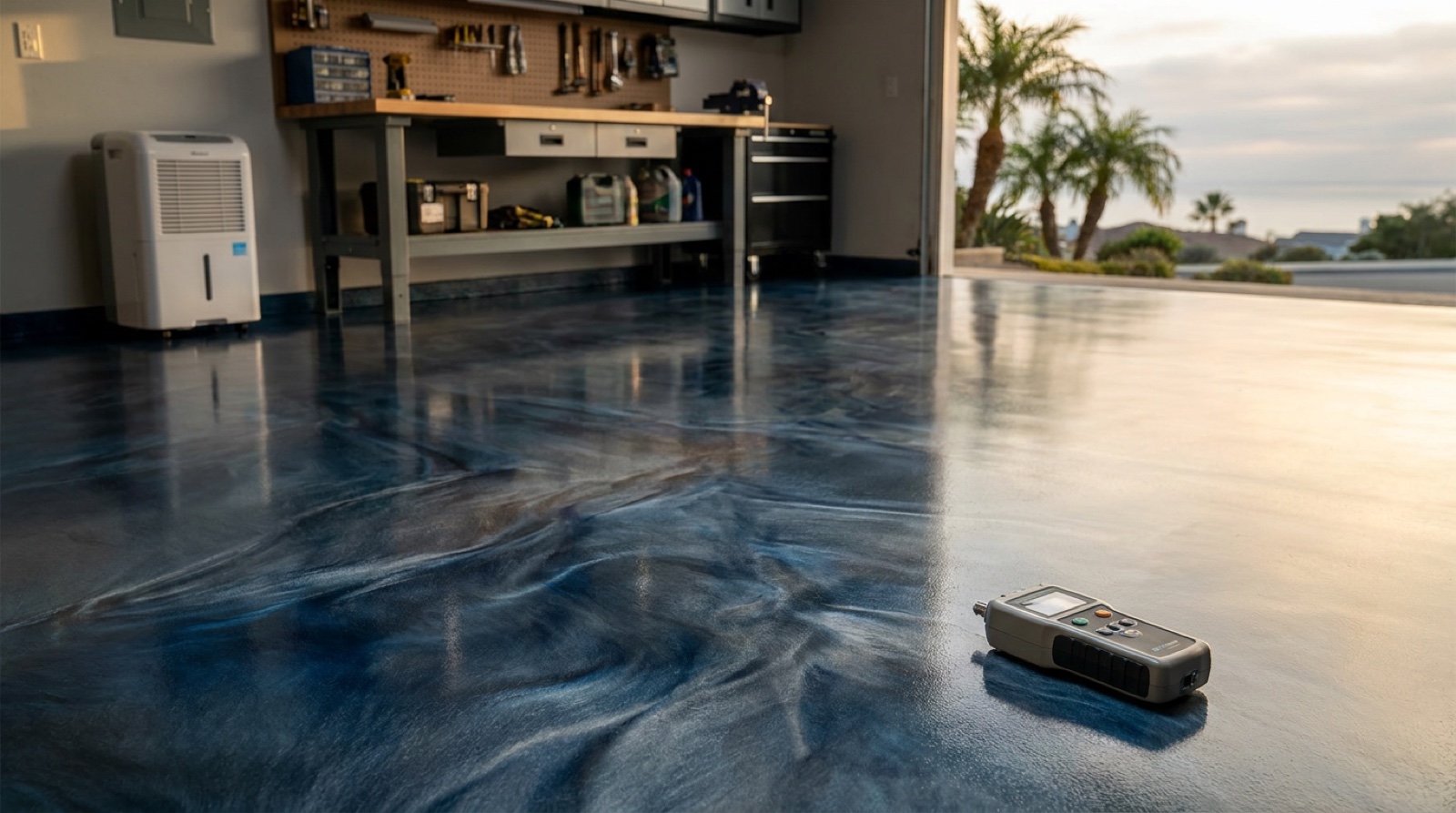
If you live within 5 miles of the OC coast, your concrete slab is wetter than you think. Coastal humidity drives moisture vapor up through unsealed concrete at rates that fail any coating without a moisture-block primer. We test every slab before we quote, and here's why.
The Science
Concrete is porous. Even fully cured, structurally sound slabs let water vapor pass through them — that's why slabs are supposed to be poured over a vapor barrier (10-mil polyethylene). The vapor moves from the wet ground below to the drier garage above, driven by the humidity gradient.
The U.S. Department of Energy and ASTM publish moisture vapor emission rate (MVER) data for residential slabs. Coastal coastal climate slabs (Newport Beach, Huntington Beach, Dana Point, Seal Beach, Laguna) average 3-5 lbs per 1,000 sq ft per 24 hours. Inland slabs (Anaheim, Yorba Linda) average 1.5-2.5 lbs.
Why It Fails Coatings
Epoxy and polyaspartic resins cure to form a continuous, non-porous film. Once that film is in place, moisture vapor coming up from the slab has nowhere to go — it builds pressure underneath the coating until the bond fails.
The failure shows up as:
- Blisters — pinhead to dime-sized bubbles in the cured coating
- Delamination — large sheets of coating lifting off the slab
- Fish-eyes — circular pock-marks where vapor pushed through during curing
- Edge peeling — vapor escaping at the perimeter slowly lifts the coating
Most of these failures show up 6-18 months after install, after warranty expectations have set in.
How We Test
Two methods are industry-accepted:
Calcium Chloride Test (ASTM F1869)
A weighed dish of anhydrous calcium chloride is sealed under a dome on the slab for 60-72 hours. The dish gains weight as it absorbs moisture. We weigh it again at end-of-test, calculate the moisture vapor emission rate, and compare to coating-specification thresholds.
Relative Humidity Probe (ASTM F2170)
A probe is drilled into the slab to a specified depth (40% of slab thickness for slab-on-grade). After equilibration (typically 24 hours), the probe reads the in-slab relative humidity. Most coatings spec below 75% RH at this depth.
We run one or both tests on every quote. Tests take 1-3 days, which is why same-day quotes from drive-by contractors are usually missing this step.
What We Do When the Test Fails
If MVER exceeds 3 lbs/1,000 sq ft/24 hr, or RH exceeds 75%, we add a vapor-block primer to the system. Two industry-standard primers we use:
- 100% solids moisture-tolerant epoxy primer — handles up to 8 lbs MVER and 90% RH
- Polyurea moisture-block — handles up to 15 lbs and 100% RH (used for severe cases)
The primer cost is roughly $1-$2 per square foot. It's the cheapest insurance you'll buy on the job.
OC Cities That Always Need Testing
Based on our 3,500+ install dataset, slab moisture vapor fails coating spec on 70%+ of jobs in:
- Newport Beach
- Huntington Beach
- Costa Mesa (south of the 405)
- Dana Point
- Laguna Beach
- Seal Beach
- Sunset Beach
It fails on 30-50% of jobs in inland OC cities. Even in Yorba Linda or Mission Viejo, we test every slab. Some test high; some don't. There's no way to know without measuring.
Red Flags From Other Contractors
If a contractor:
- Doesn't mention moisture testing in their quote
- Quotes same-day without setting up a calcium chloride or RH probe
- Says "we don't usually need to test" or "your slab looks dry"
...you're shopping with a contractor who's going to install a coating that may fail in 12-18 months. Get a second quote from someone who tests.
Get a Free OC Epoxy Quote
Call (949) 744-6229 or use the form below for a free written quote with mandatory moisture testing and lifetime warranty.