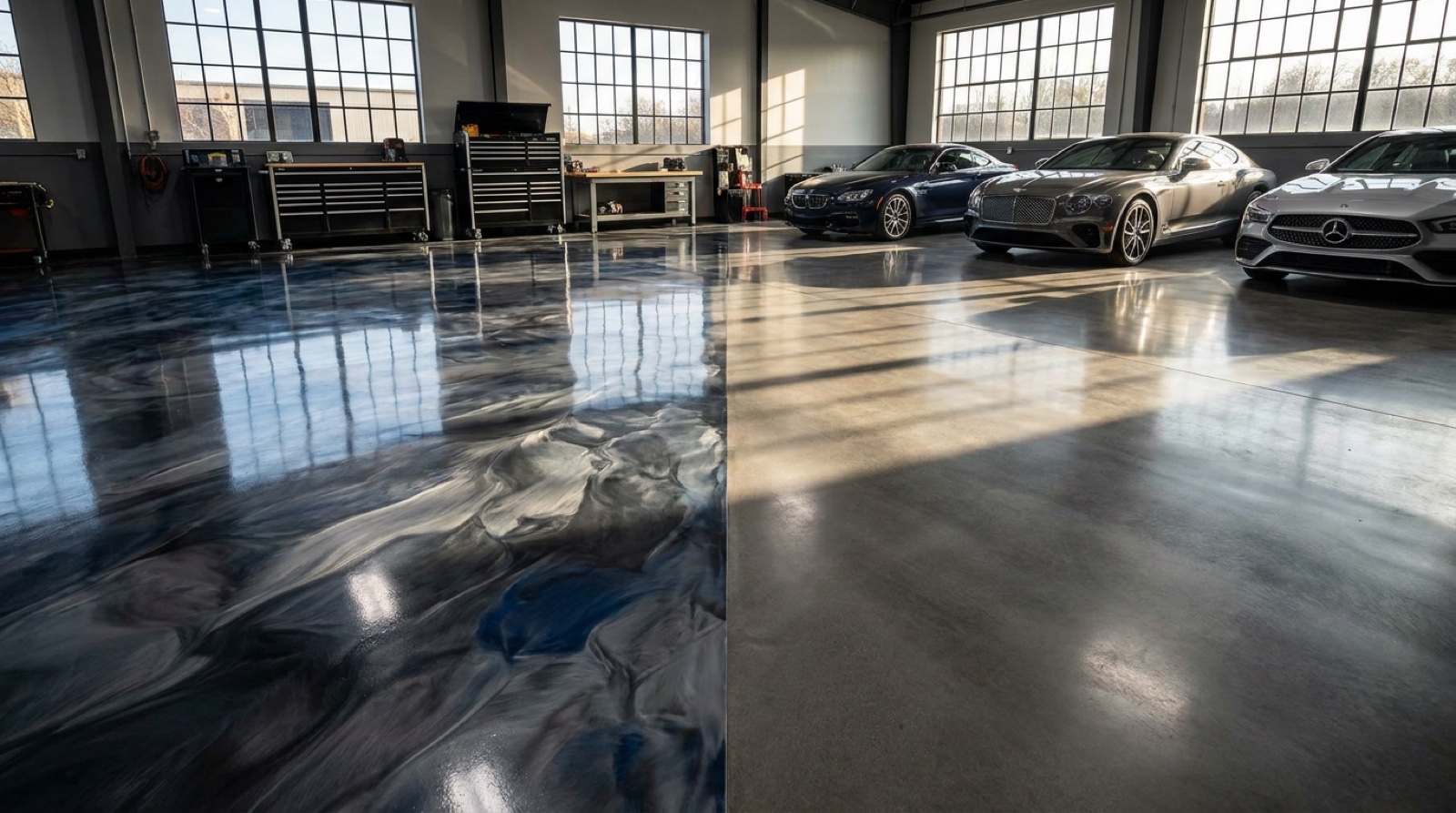
Polished concrete and epoxy coatings solve the same commercial-flooring problem with opposite philosophies. Polished concrete refines the existing slab; epoxy adds a new surface on top. Each wins different use cases, and picking based on look-and-feel alone is how facility managers end up with the wrong floor.
Lifetime
Polished concrete has a 100+ year lifespan because the concrete slab itself is the floor — there's nothing to wear off. Surface gloss may dull over 5-10 years in heavy traffic and need a re-burnish, but the floor never needs replacement.
Epoxy systems have a 15-25 year lifespan in commercial use. The coating eventually wears, gets scratched, or chemical-stained beyond recovery and needs full removal and re-coating. Cost-per-decade is a wash with polished concrete on long timelines, lower on short timelines.
Aesthetic
Polished concrete is a single-tone industrial-modern look — salt-and-pepper, exposed aggregate, optional dye for color. The honest answer is it looks like polished concrete. That's perfect for modern retail, EV showrooms, breweries, fitness studios, and tech offices. It's wrong for restaurant kitchens (no slip resistance), warehouses with chemical exposure, or branded retail wanting custom colors.
Epoxy systems support full color matching, brand striping, traffic-lane markings, decorative flake, metallic effects, and quartz broadcasts. Visual flexibility is much higher.
Cost
Polished concrete: $4-$14 per square foot installed, depending on aggregate exposure level and dye. Epoxy: $4-$20 per square foot depending on chemistry and system complexity. The cost overlap is significant; neither is categorically cheaper.
Maintenance
Polished concrete is the lowest-maintenance commercial floor on the market: dust-mop daily, damp-mop weekly with neutral cleaner, re-burnish every 5-7 years. That's it. No re-coating, no waxing, no stripping.
Epoxy systems are similar for cleaning but eventually need re-coating. Most commercial epoxy floors get a fresh top coat at 7-10 years, which costs roughly 30-40% of the original install.
Slip Resistance
Polished concrete has a low dynamic coefficient of friction (DCOF) when dry — fine for retail and office. When wet it's slippery and doesn't meet ADA's 0.42 wet-DCOF requirement without a non-slip treatment, which adds cost and dulls the gloss.
Epoxy systems with quartz or anti-slip aggregate easily exceed 0.6 wet DCOF. For restaurant kitchens, food-prep, locker rooms, and any wet environment, epoxy-quartz is the only legitimate choice.
Chemical Resistance
Polished concrete has limited chemical resistance unless sealed with a urethane or oleophobic guard. Even then, aggressive chemicals (acids, solvents, brake fluid) will etch the surface.
Epoxy systems can be specified with novolac chemistries that resist concentrated acids, jet fuel, and most industrial solvents at extended exposure. For any chemical-handling facility, epoxy wins by a wide margin.
Decision Framework
Pick polished concrete if:
- Modern industrial-minimalist aesthetic fits the brand
- Floor is mostly dry with light foot traffic
- You want lowest-possible long-term maintenance
- LEED contribution matters
- Existing slab is in good structural condition
Pick epoxy if:
- Wet environment (kitchens, locker rooms, pool areas)
- Heavy chemical or oil exposure
- Forklift or vehicle traffic
- Brand colors, logos, or traffic markings required
- Existing slab has cracks, spalling, or staining you want to hide
What About Both?
Some OC commercial spaces use both: polished concrete in the front-of-house showroom and retail areas, epoxy-quartz in the back-of-house kitchen, prep, or warehouse. We've installed several auto dealerships and restaurants this way. The transition strip between the two systems is a clean architectural detail.
Get a Free OC Epoxy Quote
Call (949) 744-6229 or use the form below for a free written quote with mandatory moisture testing and lifetime warranty.